Penrose process
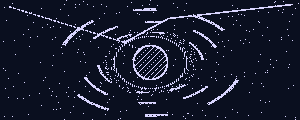
The Penrose process pulls energy out of a spinning black hole by feeding it something with negative energy. A spinning metal cylinder has now copied the black-hole runaway in a lab.
After the 1963 Kerr solution for spinning black holes, physicists realised a zone just outside the horizon lets nothing stay still. In 1969 Roger Penrose showed a particle there can carry negative energy, so swallowing it costs the hole mass and spin. In a simulation of magnetised gas falling onto a hole with spin 0.99, about 140 units of energy came out for every 100 that went in. And in a lab, a spinning metal cylinder has turned noise into a runaway signal, an electromagnetic copy of a black-hole instability.
Sources
- Schnittman, The Collisional Penrose Process (General Relativity and Gravitation, 2018)
- Tchekhovskoy, Narayan & McKinney, Efficient Generation of Jets from Magnetically Arrested Accretion on a Rapidly Spinning Black Hole (MNRAS)
- Cromb et al., Amplification of waves from a rotating body (Nature Physics, 2020)
- Braidotti et al., Amplification of electromagnetic fields by a rotating body (Nature Communications, 2024)
- Cromb et al., Creation of a black hole bomb instability in an electromagnetic system (preprint)
- Cromb et al., Creation of a black hole bomb instability, full text
- Brito, Cardoso & Pani, Superradiance: the 2020 Edition (Lecture Notes in Physics)
- Fatima & Abbas, Revisiting the Penrose Process in Rotating Black Holes with Quantum Corrections (preprint)
- Wikipedia, Penrose process
Pick a question to go deeper.
Read next
- Kardashev scaleThe Kardashev scale ranks civilizations by the power they control: Type I about Earth's own, Type II a star's, Type III a galaxy's. By Kardashev's own threshold, humanity is past Type I.
- Casimir effectThe Casimir effect is a pull between two uncharged surfaces set very close together, caused by the fluctuations of empty space. Shake that emptiness fast enough and it gives off real light.
- XenobotsXenobots are living machines built from frog embryo cells to shapes designed by AI. Set among loose cells, they shove them into piles that grow into new xenobots.