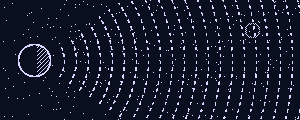
Solar gravitational lens
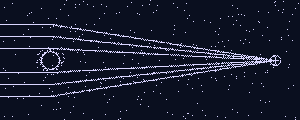
The Sun's gravity bends light like a lens, bringing it to a focus at least 550 astronomical units away. A telescope there could map a planet around another star, but only one pixel at a time.
The Sun works as a lens: its gravity bends light from a distant world to a focus far beyond it. Those planning missions there call it the only practical way to get a detailed, many-pixel image of an Earth-like planet around another star. The focus begins at least 550 astronomical units from the Sun, and no spacecraft has travelled even half that far. There is no snapshot: a 1000x1000 image of a planet at Proxima Centauri builds up pixel by pixel over about 14 months.
Sources
- Turyshev et al., Direct Multipixel Imaging and Spectroscopy of an Exoplanet with a Solar Gravity Lens Mission (2020)
- Friedman et al., A Mission to Nature's Telescope for High-Resolution Imaging of an Exoplanet (Experimental Astronomy, 2024)
- Turyshev & Toth, Resolved imaging of exoplanets with the solar gravitational lens (2022)
- Toth & Turyshev, Imaging rotating and orbiting exoplanets with the solar gravitational lens (2023)
- Landis, Mission to the Gravitational Focus of the Sun: A Critical Analysis
- Wikipedia, Solar gravitational lens
Read next
- Fermi paradoxThe Fermi paradox: life elsewhere looks likely, yet the universe we observe looks empty. Enrico Fermi, whose name it carries, never published a word about it.
- Breakthrough StarshotBreakthrough Starshot is a plan to fly gram-sized probes to Alpha Centauri on sails pushed by lasers from Earth. It has since been put on hold, with about $4.5 million of $100 million spent.
- XenobotsXenobots are living machines built from frog embryo cells to shapes designed by AI. Set among loose cells, they shove them into piles that grow into new xenobots.