Casimir effect

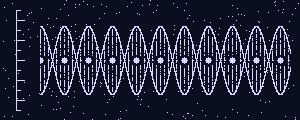
The Casimir effect is a pull between two uncharged surfaces set very close together, caused by the fluctuations of empty space. Shake that emptiness fast enough and it gives off real light.
In the late 1940s, at Philips Laboratories, Hendrik Casimir worked out that two parallel conducting plates placed very close together should attract. Nothing acts on them but empty space: quantum theory says a vacuum teems with virtual particles, and the plates alter those fluctuations in the narrow gap. The pull fades fast with distance, and it was 1997 before an experiment matched the prediction to within 5 percent. In 2011, a circuit shook that vacuum and pulled real photons out of it.
Sources
Read next
- Penrose processThe Penrose process pulls energy out of a spinning black hole by feeding it something with negative energy. A spinning metal cylinder has now copied the black-hole runaway in a lab.
- Optical atomic clocksAn optical atomic clock keeps time with ultracold atoms such as strontium. The best are now steady enough to register gravity changing across a single millimetre.
- XenobotsXenobots are living machines built from frog embryo cells to shapes designed by AI. Set among loose cells, they shove them into piles that grow into new xenobots.