Time crystals
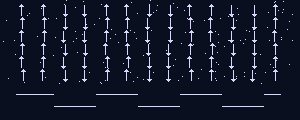
A time crystal is matter whose pattern repeats in time, as a crystal's repeats in space. The first design was proved impossible in 2014, and a driven version turned up two years later.
In 2012 Frank Wilczek, teaching a class on ordinary crystals, asked whether matter could repeat in time as a crystal repeats in space, moving forever in its lowest energy state. One lab's version has since held its rhythm for about 800 cycles, some 8 seconds, where theory allows it to run forever. Yet Wilczek's own design was proved impossible in 2014. The ones that exist are kicked by regular pulses, answer only every second one, and in theory absorb no net energy.
Sources
- Wilczek, “Quantum Time Crystals”, PRL 2012
- Zhang et al., “Observation of a Discrete Time Crystal”, Nature 2017
- QuTech, “QuTech creates a time crystal” (2021)
- Quanta Magazine, “Eternal Change for No Energy” (2021)
- Scientific American, “Time Crystals Could Be a Legitimate Form of Perpetual Motion” (2012)
- Lancaster University, “First ever observation of time crystals interacting” (2020)
Read next
- Optical atomic clocksAn optical atomic clock keeps time with ultracold atoms such as strontium. The best are now steady enough to register gravity changing across a single millimetre.
- Penrose processThe Penrose process pulls energy out of a spinning black hole by feeding it something with negative energy. A spinning metal cylinder has now copied the black-hole runaway in a lab.
- XenobotsXenobots are living machines built from frog embryo cells to shapes designed by AI. Set among loose cells, they shove them into piles that grow into new xenobots.